Beyond Quick Wins: Repeatable Processes That Scale

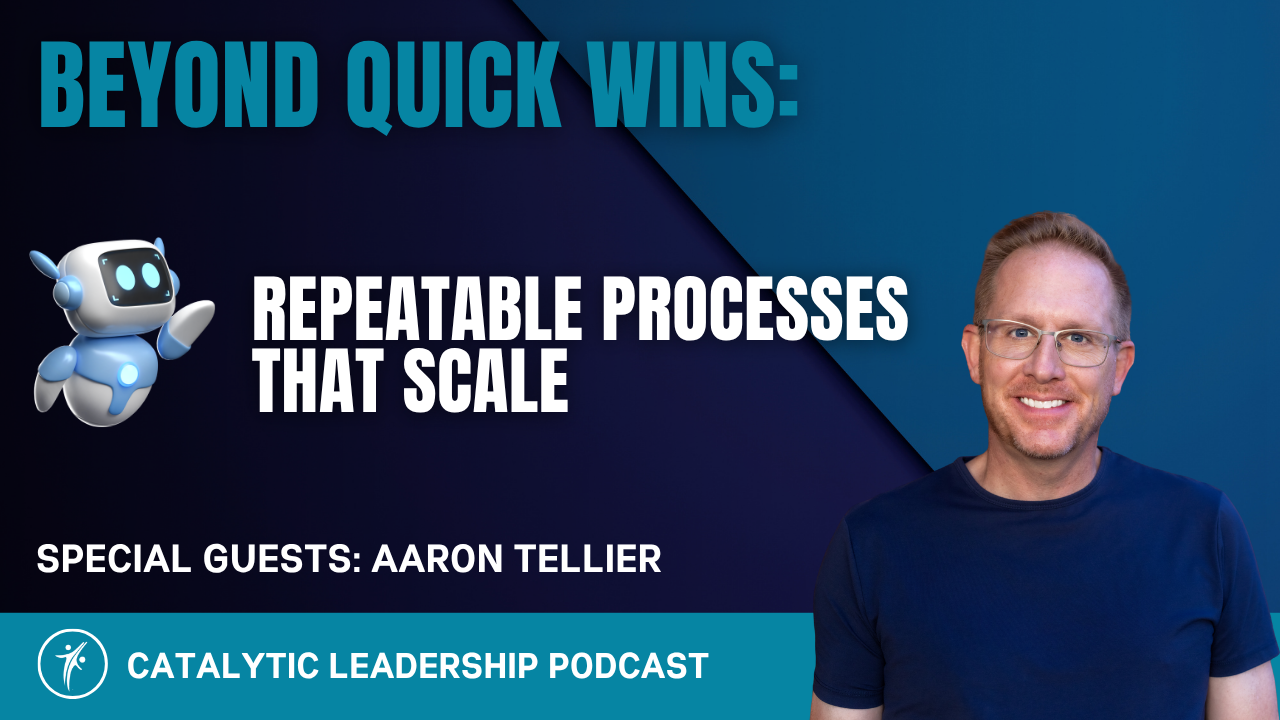
Build repeatable processes that keep creating value after the first quick win.
A new platform can be purchased quickly. A new agency can be hired. Turning either decision into a better customer experience takes sustained work. In this episode of the Catalytic Leadership® Podcast, Aaron Tellier explains how systems thinking helps a business build an advantage that lasts.
Watch or Listen: Repeatable Processes in Practice
Why Repeatable Processes Outlast the Next Quick Fix
In “Beyond Quick Wins: Repeatable Processes That Scale (with Aaron Tellier),” I talk with Aaron, managing partner and chief revenue officer at The Volute Group. He is also the founder of Ignite Studio and co-founder of Replay Brewing and Climbing Collective. His experience spans enterprise marketing and the daily realities of smaller businesses.
Aaron describes a familiar tension for CMOs. They need time to understand a company and build a capable team, while their executive peers expect evidence of progress quickly. Customer experience stretches across the organization, from product and service through sales and retention. Improving it requires cooperation and changes that can take longer than the reporting cycle allows.
That pressure can make a software purchase or a wholesale agency change look attractive. Aaron points out that each choice brings its own work. A tool needs a clearly defined problem, followed by implementation and iteration. An agency needs to learn the business before its ideas can produce meaningful results. Repeatable processes give those investments somewhere useful to land.
The Navy’s Standard: Make the Work Testable
Aaron learned to value process as a Navy engineer. Maintenance procedures specified details down to the cover on a piece of equipment. Those procedures were tested and quality-checked over time. Their value came from being reliable enough to repeat.
He brings that bias into business. When considering a special initiative, he looks at how its value could endure. One-time activities can be worthwhile, but the organization also needs work it can repeat and verify. For an agency owner, that could mean a client onboarding handoff or a recurring quality check that produces a dependable result.
For Agency Owners Adding Structure While Keeping Their Agility
This episode is useful if you are:
- Evaluating new software while still working to get value from tools you already own.
- Looking for consistent delivery without creating unnecessary approval layers.
- Helping a growing team make decisions with less dependence on you.
- Introducing AI while preserving opportunities for people to develop judgment.
Aaron sees lessons moving in both directions between large and small companies. Smaller businesses can adapt quickly. Larger organizations bring experience with strategic planning and repeatable work. He describes the value of learning where each approach belongs.
A Clear Standard Gives People Room to Act
Aaron’s portfolio has required him to adapt. A tactic that works for a climbing gym may not work for a brewery. He describes how changes in customer behavior after COVID affected the brewery experience and required many smaller adjustments.
His approach to people carries across those settings. At Merkle, he learned from David Williams that “business is personal.” He also describes working for John Lee, who made the goal clear enough that Aaron could often decide what to do without asking for permission. When he acted and made a mistake, he had support and the expectation that he would learn from it.
A Catalytic Insight from Dr. William Attaway
Aaron's description of buying a new platform stayed with me. A purchase can happen in an afternoon. Understanding the problem and helping people use the tool well takes longer. The purchase is visible. The patient work underneath it rarely gets the same attention.
I see a useful reflection here for founders. Before you approve the next fix, name the outcome you want your team to produce repeatedly. Then look at what happens today. Somewhere between your intention and the customer's experience, there may be an unclear handoff or a decision everyone assumes someone else owns. A tool cannot resolve an expectation you have never made clear.
Pick one recurring handoff this week. Ask the people on both sides to describe what a good result looks like. Listen for the places where their answers differ. Agree on who owns the next step and how you will know it worked. Try the change through a few real cycles before adding more complexity.
Aaron also described leaders who gave him room to act and supported him when he made a mistake. That matters. A process should help people build judgment, and it needs room for them to tell you when the process itself is getting in the way. Your next improvement may come from the person closest to the work. Give that person a clear standard, then make it safe to bring you what they are learning.
AI Makes Experience Worth Protecting
Aaron argues that easier access to information does not remove the need for experienced people. Leaders still need to assess whether an answer fits the situation. Their teams need opportunities to build that judgment through practice.
He cautions against removing entry points for learning or treating an AI answer as the end of someone’s thought process. Reading a whole book can matter because of the thinking that happens along the way. The same care applies when a team member works through a real problem.
Video Episode Highlights
These timestamps follow the video. The podcast audio edition includes sponsor messages, so its chapters use a separate timeline.
- 00:00 Introducing Aaron Tellier
- 01:58 The first job that revealed his strengths
- 05:48 Why CMOs need creative and analytical range
- 07:59 Short-term pressure and long-term customer experience
- 11:06 Why new software and agency changes take time
- 12:55 The Navy's lesson in repeatable processes
- 15:41 Adapting across climbing gyms, brewing and agencies
- 20:44 Learning to adapt and putting people first
- 21:44 Business is personal: mentors and team autonomy
- 24:47 AI, experience and developing future leaders
- 28:07 A forthcoming book on financial customer experience
- 30:22 Connect with Aaron Tellier
Resources Discussed
Aaron discusses a forthcoming book about customer experience in financial services and using Maslow’s hierarchy of needs as a lens. Connect with Aaron for current publication details.
Connect with Aaron Tellier
Aaron invites listeners to email him at atellier@volutegrp.com or connect on LinkedIn. He welcomes a message, a connection request or a conversation to exchange experiences.

